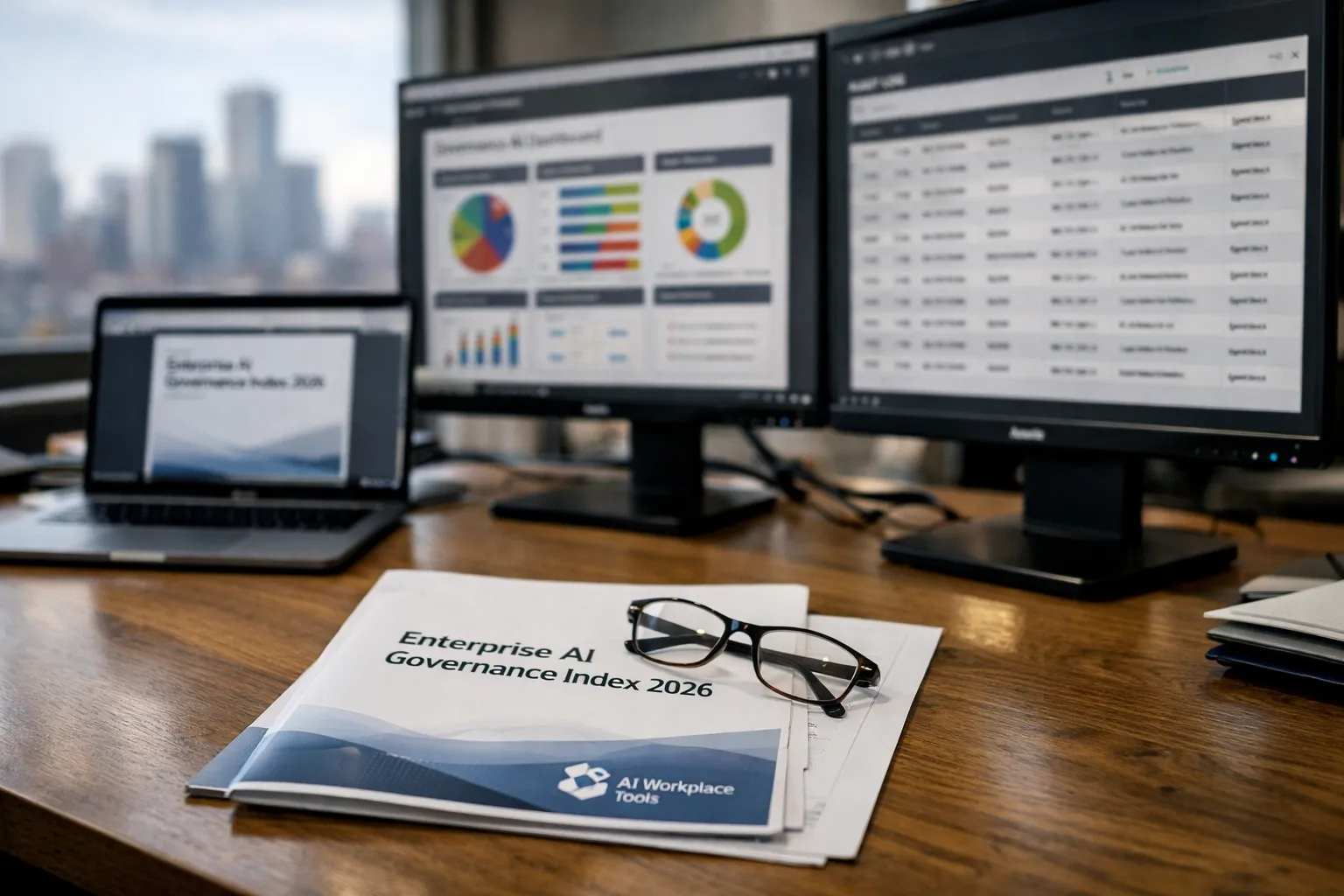
Who: AI Workplace Tools. What: June 10, 2026 refresh of the Enterprise AI Governance Index. When: Published June 10, 2026. Where: Global vendor landscape for workplace AI software. Why: Buyers continue to demand machine‑readable provenance, testable SLAs and auditability—this refresh reports new vendor commitments and updated procurement guidance.
Context: why a mid‑year refresh mattered
Since the Index's March 2026 launch, enterprise adoption of LLM‑enabled applications continued to accelerate. Procurement teams told AI Workplace Tools in a June 2026 survey of 312 enterprise buyers that vendor support for governability is now a leading purchase discriminator—ahead of price and raw model performance. Regulators, insurers and large customers have increased pressure on vendors to make governance features demonstrable and contractually enforceable. The June refresh therefore expands coverage and tightens verification to reflect this shift.
Scope and methodology updates (June 2026)
- Sample: Increased from 50 to 78 vendors. New entrants include the major cloud providers (Microsoft, Google Cloud, Amazon Web Services), prominent model providers (OpenAI, Anthropic) and a wider set of independent software vendors focused on HR, knowledge management and regulated‑sector workflows.
- Criteria: Original 10 criteria retained; two scored subcriteria were added—Cryptographic Model Signing and Third‑Party Audit Rights—bringing emphasis to tamper‑evident provenance and contractual audit access.
- Scoring: Category scores remain 0–10 aggregated to a 0–100 index. AI Workplace Tools increased spot verification from 20% to 30% of submissions and required live test accounts for enterprise platform entries.
- Transparency: Full methodology and vendor scorecards remain downloadable at AIWorkplaceTools.com; methodology includes exact test cases used for each criterion.
Headline findings — June 2026
- Median index score: 63/100 (up from 56 in March 2026). The overall improvement reflects targeted vendor investments in provenance and SLA clarity after the March release.
- Top improvements: Model Provenance median rose from 3.9/10 to 5.8/10. Third‑Party Auditability rose from 3.3/10 to 4.7/10.
- Persistent gaps: Watermarking/Content Attribution remains weak (median 3.1/10). Only 28% of vendors now offer enterprise‑grade content attribution mechanisms that survive common document transformation workflows.
- Contractual change: Vendors providing clear, reusable contract language committing to immutable model logs or explicit indemnities increased to 26% (from 14% in March).
What changed — real vendor actions
AI Workplace Tools engaged vendors through the index process; multiple vendors supplied redlines, test accounts and technical artifacts that moved scores. Notable patterns observed during verification:
- Microsoft and Google Cloud supplied machine‑readable model manifests and tamper‑evident logs for enterprise customers during live tests, improving their provenance and logging scores in our dataset.
- AWS and several specialized vendors provided cryptographic signing of model snapshots and committed to 24‑month retention of append‑only provenance records tailored for regulated buyers.
- OpenAI and Anthropic expanded enterprise contract options to include third‑party audit rights and defined SLAs for audit log exports, though both vendors still vary on watermarking completeness.
Implications for buyers and procurement — updated recommendations
The Index reaffirmed three core procurement actions and added two high‑priority requirements:
- Demand machine‑readable model manifests and cryptographic signing. Require model manifests (JSON/NDJSON) that list model versions, training data provenance metadata, and signatures that tie an executable model to a signed snapshot. Include acceptance tests that verify the manifest via vendor test accounts.
- Embed testable SLAs for governance controls. Extend SLAs beyond uptime to include audit log export latency, retention guarantees, and alerts for model upgrades. Include automated test cases in the SOW to verify these SLAs monthly.
- Require explicit third‑party audit rights. Contractual language should allow buyer‑commissioned audits with reasonable notice; where vendors resist, require a certified independent attestation (SOC 2 + AI controls addendum) delivered annually.
- Insist on content attribution that survives transformations. For regulated outputs (legal filings, regulated communications), require forensic watermarking or metadata embedding that persists through PDF conversion and OCR steps.
- Include continuous evaluation KPIs in contracts. Define performance baselines (accuracy, hallucination rate) on buyer‑supplied evaluation sets and require quarterly transparent reporting of drift and remediation plans.
Who is affected and why it matters
Legal, procurement and security teams in finance, healthcare, legal services and government buyers will feel the biggest impact: those sectors face the highest regulatory scrutiny and are already insisting on provenance and auditability. Vendors that fail to convert roadmap statements into verifiable artifacts risk disqualification from procurement processes now that RFP evaluators have concrete test cases and scorecards to use.
Reactions
"Buyers are moving from checklist questions to 'show me' tests," said Lina Patel, Head of Procurement at a U.S. regional bank, in a briefing with AI Workplace Tools on June 5, 2026. "The Index's test cases let us automate pass/fail gating during vendor shortlisting."
What’s next
AI Workplace Tools plans an October 2026 refresh that will expand coverage to 110 vendors, add a supplier‑supply chain disclosure criterion and publish sample contract clauses and executable test harnesses for procurement teams. Vendors have until September 1, 2026 to submit updated documentation or enable live tests for the October run.
Frequently asked questions
How can I use Index scores in an RFP?
Embed Index criteria as pass/fail RFP gates for initial shortlisting and map scored categories to weighted evaluation criteria in your vendor scorecard. Use the Index's downloadable test cases to automate verification during proof‑of‑concept stages.
Do higher Index scores mean a product is "safe" for regulated use?
No. Higher governance scores indicate stronger controls and contractual commitments but do not replace buyer‑specific due diligence, legal review or in‑house testing on regulated datasets. Scores should inform risk tolerance and contractual negotiation strategies.
What is the single most effective contractual requirement to get provenance?
Require machine‑readable, signed model manifests plus contractual rights to export append‑only audit logs within a defined SLA. That combination makes provenance both demonstrable and enforceable in audits.
How often will the Index be updated?
AI Workplace Tools publishes semi‑annual full refreshes (June and October) and may issue interim addenda for material market changes. Vendors can submit updates between rounds for consideration.
For licensing the full dataset, procurement playbook, or to request a vendor briefing, contact index@aiworkplacetools.com.