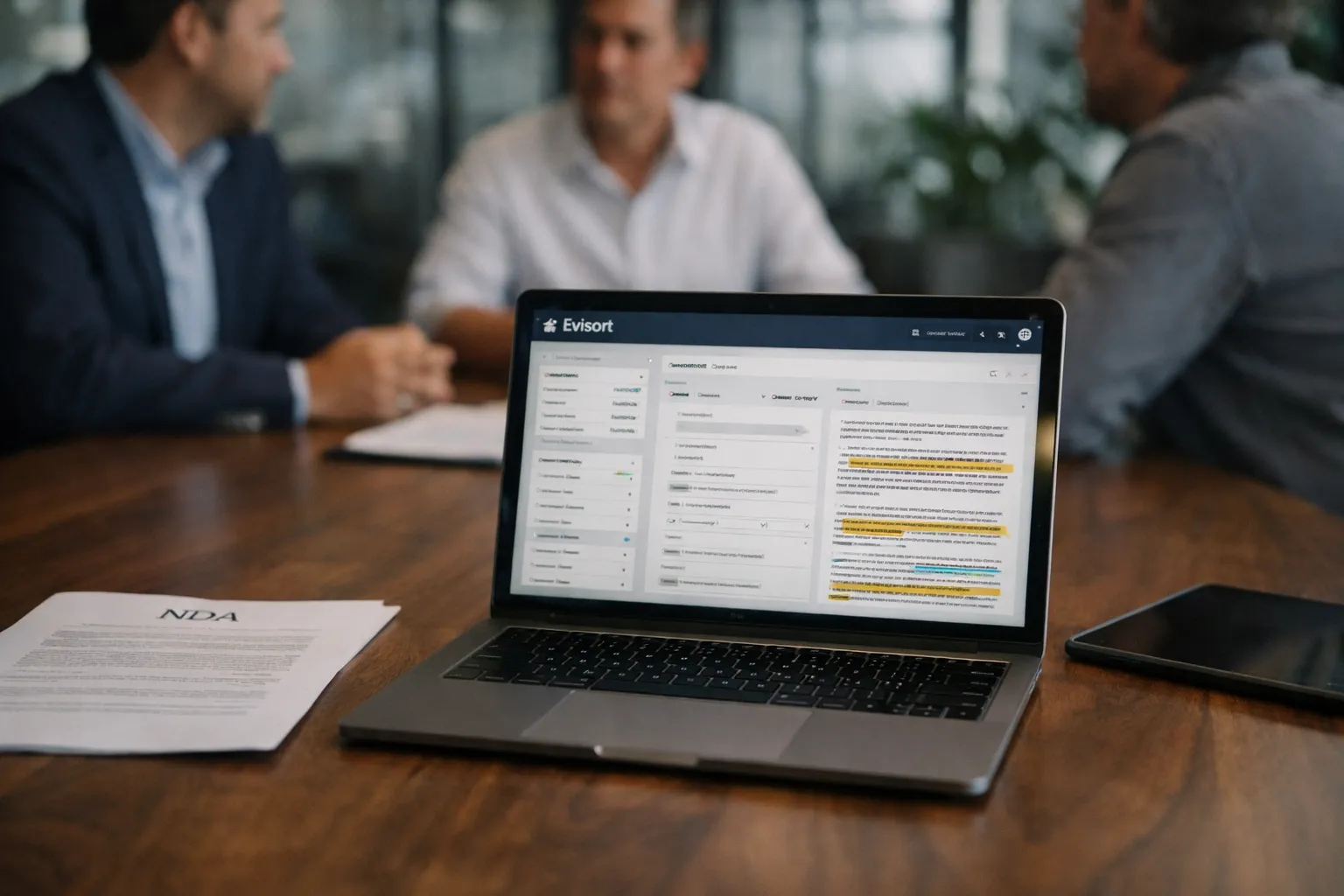
This is a July 2026 update to our hands‑on review of Evisort’s contract lifecycle management (CLM) platform. The core conclusion from earlier in 2026 still stands: Evisort is an AI‑first CLM built around automated extraction, clause search, workflow automation and traceable answers. What has changed in the market—and what buyers now ask for—shifts how you should evaluate and deploy the product.
Overview: What we’re reviewing
What this review covers: Evisort’s extraction and tenant models, clause and obligation search with provenance, workflow/playbook automation, connectors (eSignature, CRM, document stores), admin and security controls, and the platform’s audit trail and reporting. Testing used a mixed corpus representative of legal and procurement teams: NDAs, MSAs, SOWs, purchase agreements and a portion of scanned legacy contracts. Testing focused on onboarding, model customization, search provenance and day‑to‑day workflows.
Background: Who makes this and who it’s for
Evisort positions itself for mid‑to‑large legal and procurement organizations that need automated extraction at scale plus an evidence trail for audits. The vendor emphasizes AI models that live at tenant level, human‑in‑the‑loop correction, and workflow orchestration without code. In 2026 the broader CLM market has matured: buyers expect not just extraction and storage but explainability, data residency options, and guaranteed SLAs for model performance. That context matters when choosing between CLM vendors.
Features analysis — deep dive
- Extraction and model customization: Evisort’s annotation UI remains efficient for correcting extracted metadata (parties, effective/expiry dates, auto‑renewal terms, notice periods). Tenant‑level retraining feeds corrections back to the model; firms that commit to regular curation see continuous uplift. For messy, scanned archives, expect preprocessing (improved OCR, manual correction) before extraction reaches enterprise accuracy levels.
- Search and provenance: The platform surfaces clause‑level matches with document snippets and links to source PDFs, plus an audit trail that identifies who validated an extraction and when. In today’s environment, buyers also ask for cryptographic evidence of provenance and exportable, immutable logs for auditors—verify the vendor’s export formats and retention policies during procurement.
- Workflows and negotiation support: No‑code workflow editors still let legal ops build intake forms, conditional routing and approval gates. Compared with early 2026, buyers now expect richer negotiation support—bulk redline actions, preferred clause libraries integrated into redline flows and clearer version reconciliation. Evisort’s workflow tools cover most operational needs, but organizations with highly bespoke negotiation playbooks sometimes pair Evisort with specialist negotiation tools.
- Integrations: Mature connectors for DocuSign/Adobe Sign, Salesforce and Microsoft 365 remain key. Practical takeaway: connectors work best with clear field mappings and governance rules; plan integration tests that include edge cases (split documents, amendments, scanned executed copies).
- Security, compliance and data governance: Enterprise features (SSO, RBAC, encryption at rest and in transit, audit logs) are table stakes. Today, procurement teams also demand data residency options and contractual commitments on model usage and training data; confirm where production and backup copies are hosted and how the vendor uses operational telemetry.
Pros and cons — updated context
- Pros: Configurable extraction, clear clause provenance, no‑code workflows, mature integrations and tenant modeling that benefits from sustained human curation.
- Cons: Implementation overhead remains meaningful for medium‑to‑large deployments; scanned/legacy document quality still drags accuracy; non‑English and niche language coverage lags leading‑edge multilingual models; pricing and TCO require careful negotiation (see pricing section).
- New 2026 caveat: With rising regulatory scrutiny of generative AI and model explainability, buyers must validate Evisort’s contractual commitments on model behavior, data use, and incident response as part of the security review.
Pricing and value — practical guidance
Evisort sells primarily through custom enterprise quotes rather than a public, line‑item price list. That means price depends on seat counts, ingestion volume, API or inference usage, required integrations, SLAs and professional services. In the modern CLM market, procurement commonly sees these billing patterns:
- Per‑seat SaaS licenses or role‑based bundles for frequent users;
- Organization or site licenses for large deployments with usage caps for API calls or document processing;
- One‑time professional services for taxonomy mapping, integrations and model tuning (typical market ranges for implementation services are tens of thousands to low hundreds of thousands of dollars depending on scope);
- Optional fees for add‑ons: advanced OCR, additional language packs, or premium support/SLA tiers.
Exact numbers vary; ask the vendor for a sample TCO for your environment: projected document volumes, expected monthly API/inference calls, estimated professional services days, and renewal escalation clauses. Negotiate audit‑friendly SLAs that include accuracy validation windows and remediation commitments during your pilot.
Who should buy it?
- Mid‑to‑large legal departments that want to centralize contract data, automate routine extraction and require clause‑level provenance for audits or regulators.
- Procurement teams that need to surface and act on non‑standard payment or delivery terms across thousands of agreements.
- Regulated industries (financial services, healthcare, energy) that must prove the origin of contract findings and maintain strong access controls.
Smaller teams with under a few hundred contracts and minimal integration needs should evaluate lighter CLM tools or managed services before committing to an enterprise CLM footprint.
Alternatives — two to consider
- Ironclad: Strong negotiation workflows and a widely used contract repository; good for teams prioritizing negotiating playbooks and UI‑driven redlining.
- Icertis / Agiloft: Mature enterprise CLM options with deep configuration and global deployment experience; often chosen by very large regulated organizations that need complex entitlement and global data residency controls.
Verdict — who should pilot Evisort now
Evisort remains a mature contract‑AI platform in July 2026: strong on extraction, provenance and integration. Its best use is as an operational data platform for legal ops and procurement—when teams treat contract text as structured data rather than simply archival PDFs. Expect a meaningful implementation window, and budget for professional services and an internal taxonomy owner. If your organization needs clause‑level traceability, out‑of‑the‑box integration with common enterprise systems and tenant‑level model tuning, Evisort is a robust candidate for pilot. If you need a lightweight, plug‑and‑play solution for a very small team, evaluate lower‑cost CLMs first.
Quick checklist before buying
- Run a pilot with a representative and challenging sample (including scanned copies and non‑standard contracts).
- Map integrations and perform end‑to‑end tests of API flows, signature ingestion and CRM syncs.
- Confirm security certifications, data residency options and contractual commitments on model use and incident response.
- Budget for professional services and assign a sustained taxonomy owner in legal ops for iterative improvement.
- Negotiate SLAs that include accuracy validation periods, remediation paths and transparent pricing for inference/API overages.
Updated operational tips for July 2026
- Prioritize onboarding of high‑value contract types (renewals, high‑risk vendors) during the pilot to show measurable ROI early.
- Plan for continuous model governance: schedule quarterly accuracy audits and keep an exportable snapshot of training labels for audit purposes.
- Include non‑English samples early—don’t assume English performance will generalize—and test OCR pipelines for legacy scans before bulk ingestion.
- Document your data retention policy and ensure the vendor’s export formats align with internal eDiscovery needs.
Will Evisort handle my scanned legacy contracts?
Evisort handles scanned documents, but OCR quality significantly affects extraction accuracy. For large scanned archives you should include a preprocessing phase: OCR improvements, manual correction of critical fields, and a representative sample in the pilot to validate expected accuracy. Plan time and budget for this work.
How does provenance work in practice?
Evisort surfaces clause‑level matches with document snippets, links to source files and an audit trail showing who validated or corrected an extraction. For audit or regulatory requirements, verify export formats, retention policies and whether the vendor provides immutable or cryptographically verifiable logs if your compliance program requires them.
What internal team is needed to get value?
Most customers allocate a legal ops owner (part‑ or full‑time) responsible for taxonomy curation, validation of model updates and integration governance. Expect support from IT for SSO, data connections and security reviews, and occasional vendor professional services during the initial rollout.
Can Evisort replace specialist negotiation platforms?
Evisort covers versioning and redlines and supports many negotiation workflows, but organizations with highly specialized negotiation playbooks sometimes continue to use specialist negotiation tools in tandem. Evaluate negotiation use cases during the pilot to see whether the platform meets your redline and clause‑library requirements.