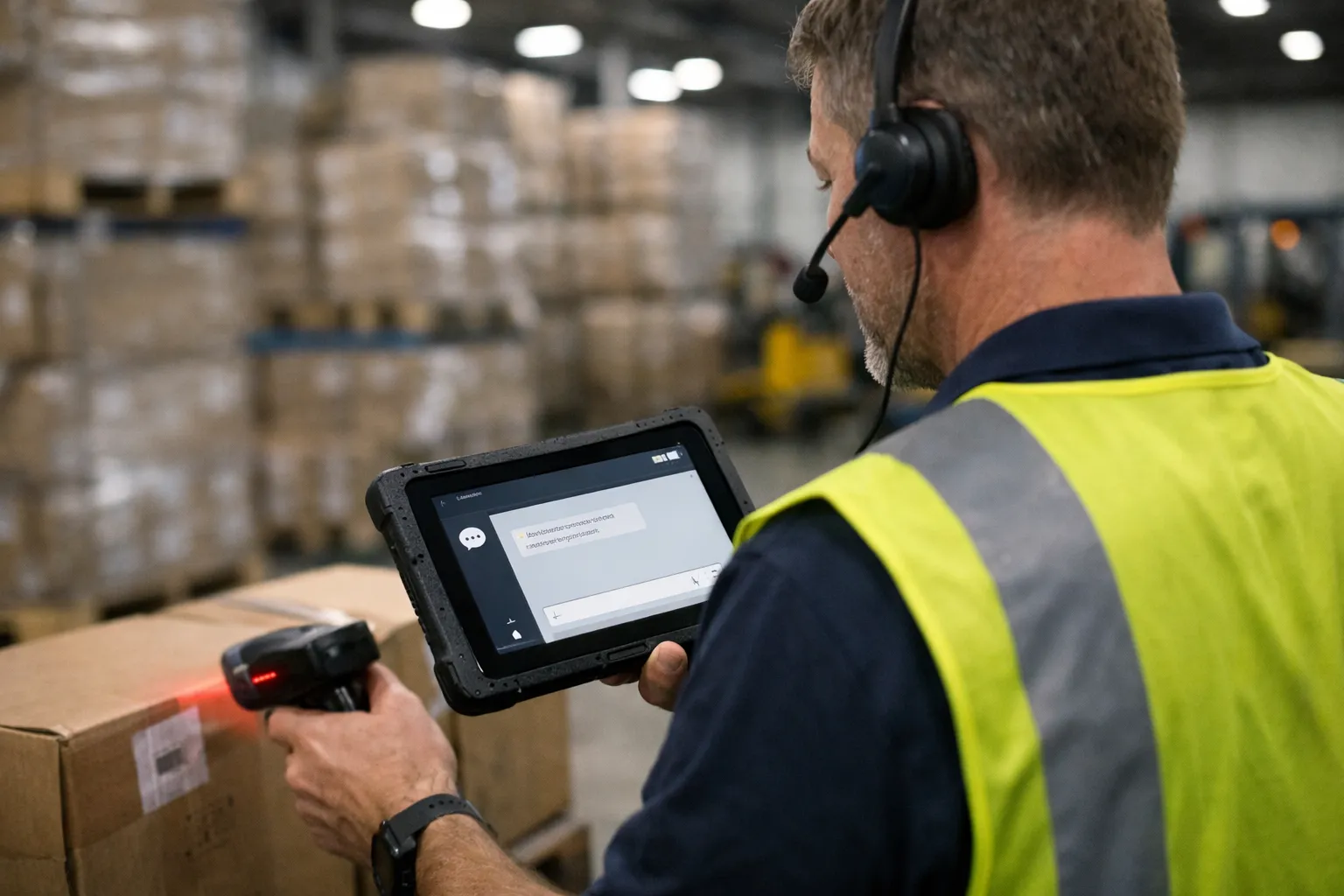
Overview: This update explains why on-device LLM inference remains a strategic option for frontline workers in August 2026, what’s changed since 2024, and how enterprises should reframe procurement, MLOps and governance. The core trade-offs remain—latency, capability and cost—but market, regulatory and tooling shifts over the past two years change the practical calculus for pilots and scale.
Background: what’s shifted since 2024
Two years ago the choice was primarily architectural: cloud-first for capability, on-device for latency and privacy. Since then three converging changes have made on-device deployments materially more practical:
- Silicon and runtime maturation: Mobile and embedded SoCs shipped in 2024–2026 include larger NPUs and better memory subsystems; vendor toolchains (NNAPI, Core ML, TVM/Apache-OpenVINO derivatives) provide smoother paths from model to optimized binary.
- Model engineering advances: Production teams now routinely use low-bit quantization (3–4-bit), structured pruning and instruction-tuned micro-models (300–800 MB) that preserve task performance for domain-specific prompts.
- Regulatory & procurement pressure: Enforcement activity under the EU AI Act and updated U.S. guidance on consumer data handling has pushed firms to prefer local inference for regulated workflows (health, finance, sensitive retail profiles).
Data and evidence: what practitioners report in 2026
Practicing teams and vendor case studies since 2024 report several measurable effects:
- Latency improvements: On-device models now commonly deliver sub-150ms median response times for short prompts (lookup, checklist guidance), improving worker throughput in pilots run by retailers and field service teams.
- Cost sensitivity: Large fleets issuing hundreds to thousands of short queries per worker per day report cloud spend reductions large enough to amortize higher-device cost within 12–24 months, especially where network bandwidth or API costs were previously significant.
- Model quality per MB: Instruction-tuned tiny models and domain-tuning have narrowed the quality gap for routine tasks—many frontline workflows see parity with cloud answers on templated tasks; complex multi-step reasoning still favors cloud hosts.
- Operational overhead: Device diversity remains the biggest operational cost—testing and signing models for tens of device classes consumes a disproportionate share of pilot budgets.
Multiple perspectives: CIOs, CISOs, and frontline managers
- CIO / Ops: Favor hybrid patterns that maximize uptime and limit capital expense; many CIOs now treat on-device models as part of the device procurement spec (NPU, secure boot, OTA support).
- CISO / Security: On-device reduces network exposure but increases endpoint attack surface. Security teams emphasize hardware-backed key stores, attestation, and continuous integrity checks for signed models.
- Frontline managers: Value responsiveness and offline reliability—teams see measurable reductions in task completion time when assistants are local and responsive vs. cloud roundtrips during peak hours or in basements/warehouses with spotty coverage.
Technical trade-offs in 2026: updated framing
The foundational trade-offs still hold, but tactics have evolved:
- Model fidelity vs. size: New compression techniques (mixed-bit quantization, layer-wise distillation) improve fidelity for tasks with constrained vocabularies. But for anything requiring up-to-the-minute external knowledge or long-context multi-hop reasoning, remote models remain necessary.
- Latency vs. capability: Adaptive offload patterns are now standard: devices attempt a fast local inference, then escalate selectively based on confidence scoring, content-sensitivity tags, or latency budget.
- Energy & thermal: Device schedulers and dynamic frequency scaling are more sophisticated; long-tail heavy workloads are commonly routed to onsite edge servers (micro data centers) to avoid battery and thermal impact on handhelds.
Deployment patterns: five practical 2026 architectures (revisited)
- Fully on-device: Best for offline-first, privacy-sensitive apps. Now more feasible due to smaller, certified models and standardized signed-model packaging.
- Local edge appliance: Rack or micro data center at site for heavier inference; useful for factories or large stores where many devices can share a low-latency local endpoint.
- Hybrid / adaptive offload: Small local model for routine queries; confidence-based or policy-based escalation to edge/cloud for complex queries.
- Cloud-first with local cache: Cloud model as primary but with sanitized local caches and ephemeral model snippets for disconnect scenarios.
- Federated distillation & hybrid learning: Devices contribute gradients or distilled updates; central aggregation (often differential-private) updates production models without raw data centralization.
Cost drivers and updated TCO considerations
Three 2026 realities change the TCO balance:
- Lower silicon premiums: Competition among device silicon vendors compressed the device-price premium for capable NPUs, reducing capital barriers.
- More open, certified small models: The growth of vetted small-model catalogs reduced proprietary model licensing in many pilots—vendors provide certified model bundles optimized for popular SoCs.
- Engineering & testing remain costly: The dominant recurring cost is cross-device validation, security attestations, OTA orchestration and human review pipelines for safety—these are not commoditized.
Practical TCO rule: on-device makes economic sense when per-user query volume is high, offline/latency requirements are material, or regulatory constraints limit cloud transmission. Expect break-even in 12–24 months for fleets of several thousand devices with heavy usage; smaller fleets or low-frequency tasks usually remain cloud-first.
Governance, privacy and compliance: new dynamics
Regulation and audit requirements have tightened.
- Regulatory push: Enforcement under the EU AI Act and national data-protection authorities has increased scrutiny of where inference and data processing occur. Local inference reduces cross-border transfer issues but does not eliminate obligations for model explainability and safety.
- Model provenance & supply chain: Signed-model artifacts, reproducible builds, and standardized model manifests are now procurement line-items for many regulated buyers. Device attestation plus immutable model fingerprints are standard controls in regulated sectors.
- Telemetry & auditability: Firms must design telemetry that is privacy-preserving yet sufficient for QA and compliance. Techniques used in production include sampled human review, on-device differential privacy, and hashed audit logs that preserve traceability without exposing raw PII.
- Security threats: Model extraction, poisoning, and jailbreaks remain live risks. Organizations favor layered defenses: secure enclaves for model keys, signed update channels, remote attestation and continuous red-team testing.
Operationalizing on-device LLMs: updated MLOps & security practices
Operational best practices that have emerged in 2025–2026:
- Hardware-in-the-loop CI/CD: Include representative devices in CI pipelines; automate latency, memory, and battery burn-in tests.
- Phased rollouts & safety gates: Canary deployments, behavioral monitoring and human-in-the-loop fail-open policies for sensitive workflows.
- Telemetry strategy: Capture lightweight signals (confidence, error codes, anonymized hashes of outputs) and a small percentage of flagged outputs for human review under strict consent controls.
- Security lifecycle: Signed model artifacts, revocation lists, and emergency rollback are mandatory; tie model signing to hardware attestation and MDM controls.
- Vendor and contract clauses: Require SLAs for model updates, patching, and forensic support; confirm liability allocation for model-caused harms.
Decision framework: updated checklist for August 2026
- Is sub-200ms or offline response essential? Favor on-device or edge-server.
- Is query volume high and repetitive? On-device likely reduces variable cloud spend.
- Does the task demand continuous world knowledge or deep multi-step reasoning? Keep cloud-hosted specialist models in the path.
- Can your organization sustain device validation, signed-model governance and security ops? If not, consider managed hybrid offerings or vendor-certified bundles.
- Do procurement and legal teams require model provenance and signed artifacts? If so, ensure model manifests and attestation are contractual requirements.
Practical recommendations for enterprise teams in 2026
- Start with a narrow pilot that values latency or offline behavior—inventory scanners, safety checklists, or step-by-step repair guides.
- Adopt adaptive offload: local-first inference with confidence-based escalation to edge/cloud to preserve UX while limiting cloud cost.
- Design telemetry with privacy-first defaults: sample conservatively, use hashing/differential privacy, and keep legal and compliance in the loop.
- Contract for signed-model supply and attestation; require vendors to provide forensic support and signed update channels.
- Invest in device-in-the-loop CI, phased rollouts and red-teaming focused on model jailbreaks and data-exfiltration vectors.
Outlook: what to watch next
Through the rest of 2026 you should watch three dynamics:
- Standardization of signed-model packaging and attestation: Expect industry alignment on manifests and provenance tooling that reduce vendor lock-in over the next 12–18 months.
- Certified micro-model marketplaces: Marketplaces of vetted, hardware-optimized micro-models and verification tooling will lower integration friction.
- Regulatory enforcement contours: Enforcement actions under the EU AI Act and consumer-protection agencies will further shape data-handling expectations and contractual obligations.
FAQ: Common questions right now
Is on-device inference strictly safer for privacy?
Not automatically. On-device inference reduces network exposure, but privacy gains depend on design: local caches, telemetry, and synchronization policies can reintroduce risks. Governance—signed models, attestation, strict telemetry sampling and legal controls—determines privacy outcomes.
When should I pick hybrid over fully on-device?
Choose hybrid when you need the responsiveness of local inference for routine queries but still require cloud-level capabilities for complex reasoning, models that need frequent world updates, or centralized oversight for quality and compliance.
How much will device procurement cost rise for NPU-capable hardware?
Device premiums have narrowed in 2024–2026; many organizations report modest per-device increases offset by lower cloud spend at scale. The dominant cost remains engineering and validation rather than silicon price in most enterprise pilots.
What governance controls are now considered mandatory?
Signed-model artifacts, device attestation, phased rollouts, sampled privacy-preserving telemetry, and contractual clauses for updates and forensic support are standard expectations for regulated enterprises deploying on-device LLMs.