Two architectural patterns continue to dominate enterprise LLM deployments in August 2026: explicit orchestration pipelines (deterministic workflows) and agent-based frameworks (autonomous, tool-using agents). Both remain essential, but the landscape has evolved—regulation has crystallized, tooling matured, and production risks have produced new operational best practices. This update explains what changed since mid‑2024, where each pattern now wins, and how to combine them safely and economically at scale.
Background: why this matters now
Enterprises moved beyond proofs‑of‑concept to large‑scale LLM production in 2024–2026. Two pressures shaped architecture choices: stronger regulatory scrutiny (notably operationalization of the EU AI Act and increased sectoral guidance from regulators worldwide) and the operational reality of model costs and behaviors. Organizations that rushed agent deployments without robust governance encountered cost overruns, audit gaps, and safety incidents. Conversely, groups that constrained innovation with overly rigid pipelines missed productivity gains. The current challenge is selecting a pattern that balances innovation, cost, latency and compliance.
What’s changed since 2024–25
- Regulatory clarity and compliance tooling: The EU AI Act’s market surveillance and fines, along with guidance from national regulators and NIST's AI Risk Management Framework updates, put provenance, risk classification, and incident reporting front and center. Vendors now ship compliance connectors and artifact export features as standard.
- Tooling maturity: Observability for agent workflows—per‑action tracing, causal provenance, and standardized audit exports—has become mainstream. Workflow platforms (Temporal, Dagster, Prefect and equivalents) include first‑class LLM and agent plugins; agent frameworks offer "agent contracts" and budget controls out of the box.
- Model economics and architecture innovations: Model distillation, retrieval‑augmented generation improvements, and specialized smaller LLMs for validation and classification reduced average cost per transaction. At the same time, the prevalence of multi‑stage LLM ensembles and on‑device inference for low‑risk tasks affects cost/latency tradeoffs.
- Hybridization as default: Mature adopters standardize hybrid patterns—deterministic controllers orchestrating bounded agents for exploratory subtasks—rather than choosing one model exclusively.
Head‑to‑head: updated operational and technical trade‑offs
1) Predictability, auditability and regulatory fit
Orchestration: Still the best fit where audit trails, deterministic testing and data lineage are mandatory—payments, KYC, regulated contract review and clinical decision support. Orchestrators now export immutable execution artifacts (inputs, model versions, tool calls) in regulator‑friendly formats.
Agents: Agents can meet regulatory requirements but need structured constraints. Best practice is to attach a controller that issues an agent contract—a signed manifest that limits tools, time, call budgets and states required logging. Without this, autonomous behavior increases compliance risk.
2) Cost, performance and predictability
Orchestration: Remains easiest to optimize: you control the number and size of model calls, can cache intermediate outputs, and substitute cheaper models for validation. New cost controls include "preflight surrogate checks"—fast classifiers that decide whether an expensive generation is needed.
Agents: Improved since 2024: budgeted agents and adaptive pruning limit runaway loops. Still, open agent loops can incur higher and variable costs. Use agents for low‑volume, high‑value exploratory tasks or when iterative search materially increases value.
3) Reliability and failure modes
Orchestration: Easier to isolate faults and enforce idempotency across steps. Rollbacks and retries are straightforward.
Agents: New mitigations—action limits, sandboxed tool execution, and runtime monitors—reduce stuck loops and hallucinated tool use. However, agent error modes are subtler (misplaced planning steps, partial data exposure via tool misuse) and require specialized monitoring.
4) Developer productivity and iteration speed
Orchestration: More upfront design work but yields durable, testable systems. Developer velocity improves with declarative workflow DSLs and model contract tests.
Agents: Remain the fastest path to prototypes and can accelerate researcher workflows and synthesis tasks. The trick is to convert successful agent patterns into hardened, orchestrated micro‑workflows for production.
5) Observability and operational tooling
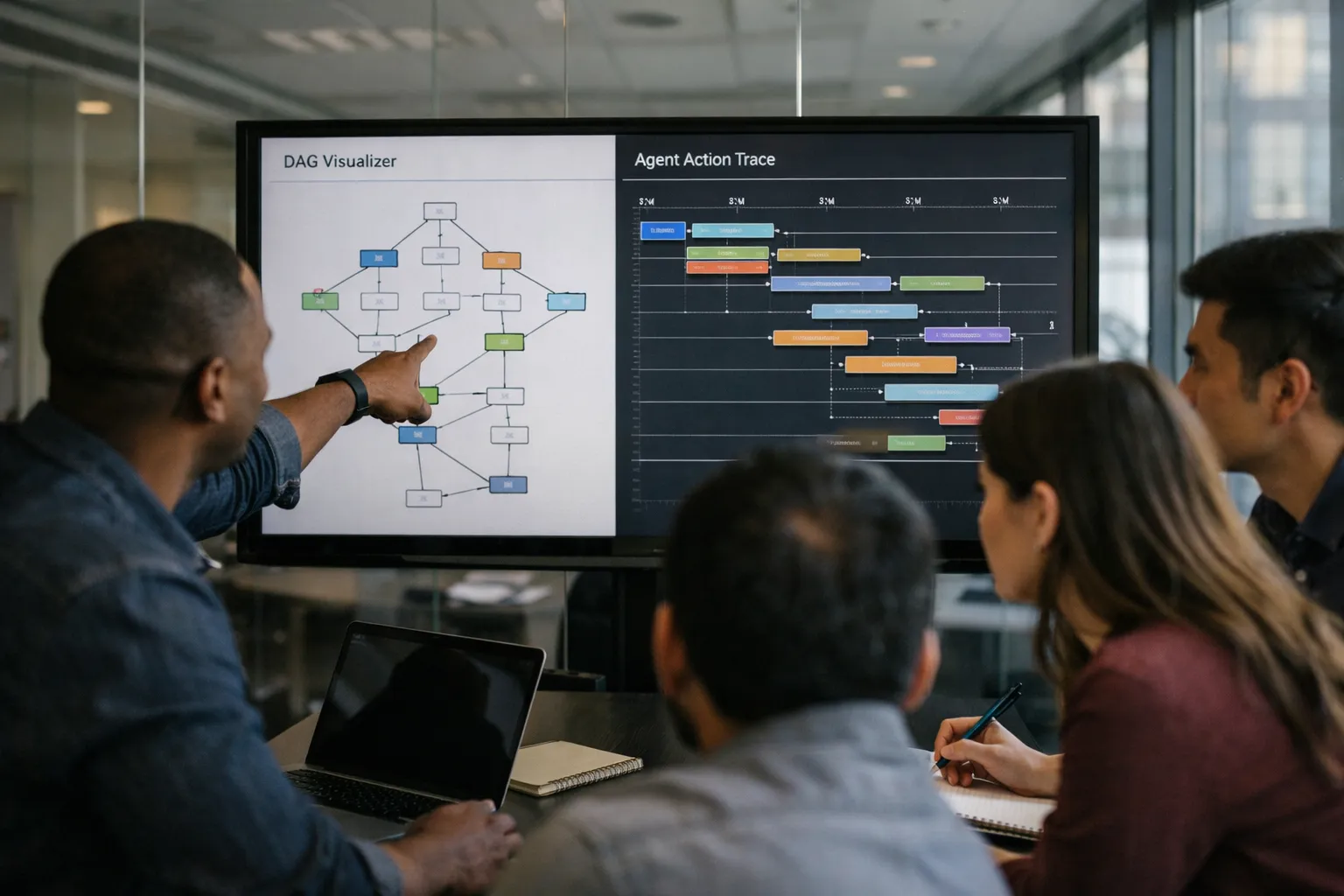
Agent observability is now a distinct product category: per‑step rationales, tool call manifests, and "provenance scores" that quantify trace completeness. Orchestration observability benefits from established traces and DAG visualizers. Expect to operate both kinds of monitoring alongside centralized governance consoles.
Use‑case guidance: updated recommendations
- Regulated transactional workflows (banking, insurance, healthcare): Orchestrate. Enforce model version pinning, schema validation and immutable audit exports for each transaction.
- High‑volume customer automation (billing, HR self‑service): Orchestrate for predictable latency and cost. Use small local models for triage and escalate to a bounded agent only when the issue is complex.
- Research, multi‑source synthesis, market intelligence: Agents can outperform static pipelines. Run agents in segregated analysis enclaves with strict budget contracts, export full traces for reproducibility, and subscribe outputs to a human review gating process.
- Developer productivity tools (code generation, data exploration): Start with agents for iteration, then lock critical steps—commits, infra changes—behind deterministic pipelines and precommit checks. li>Hybrid analytics: Orchestrate data ingestion and cleaning; invoke agents only for bounded synthesis tasks (document triage, outlier explanation).
Practical hybrid patterns that work in 2026
- Controller‑first, agent‑bounded: A deterministic controller orchestrates data and policy, spins up a bounded agent with a signed contract for a subtask, and enforces timeouts and audit exports.
- Tool catalogs with capability tags: Agents operate against a scoped catalog of tools with declared capability tags (read‑only search, write‑only ticketing). Governance layers enforce tool level permissions at runtime.
- Policy gateways: Centralized policy services validate outputs (PII redaction, toxicity checks, schema conformance) before externalizing agent outputs or committing them to downstream systems.
Updated operational metrics to track
In addition to the classic metrics (LLM calls per transaction, token cost, latency, tool success rate), add:
- Agent action distribution: mean and P95 number of actions per completed task
- Provenance completeness score: fraction of executions with full tool‑call trace and model hash
- Hallucination incidents per 1,000 outputs: flagged by human reviewers or automated detectors
- Contract violation rate: percentage of agent runs that exceed declared budgets, tools, or timeouts
- Model drift alerts: frequency of semantic drift from gold standards
Production checklist — updated for August 2026
- Immutable, exportable audit artifacts for every execution (inputs, model IDs, tool calls, outputs).
- Agent contracts that specify allowed tools, call budgets, timeouts and required logging.
- Schema and type validation for all structured outputs plus automated redaction policies for PII.
- Cost circuit breakers and surrogate "preflight" checks to prevent expensive LLM generations on low‑value requests.
- Human‑in‑the‑loop gating for high‑risk decisions and rollback playbooks tested end‑to‑end.
- Automated compliance reports tied to regulatory categories (high/medium/low risk) for audit preparedness.
Multiple perspectives
Enterprise architects emphasize predictability and compliance, favoring orchestration and controller patterns. AI researchers and product teams emphasize the creative power of agents and argue that bounded autonomy unlocks new user experiences. Legal and compliance teams push for agent contracts and immutable provenance. Vendors respond with hybrid product features: both workflow orchestration and agent governance baked into a single control plane.
Implications for readers
If you lead or advise enterprise AI projects, the immediate priority is risk‑aligned architecture. For high‑risk, high‑volume lines of business, prefer orchestration and convert agent prototypes into bounded services. For research, synthesis, and developer productivity, use agents but instrument every run and require contractized execution for production use. Start instrumentation early: you cannot reliably retro‑engineer provenance and cost trends after wide rollout.
Outlook: what to watch next
- Regulatory enforcement patterns: expect regulators to audit artifact exports and provenance in the next 12–18 months.
- Standardization of agent contracts and audit formats: industry groups are converging on a small set of export schemas; adopting them early reduces integration friction.
- Continued model specialization: expect smaller, cheaper foundation models tuned for validation, classification, and safety checks to become standard complements to large generators.
- On‑device and hybrid inference: low‑risk tasks will increasingly run at the edge, changing latency and cost calculus.
Conclusion
Orchestration pipelines and agent frameworks remain complementary. The practical default in 2026 is hybrid: deterministic controllers that exploit agent capabilities in bounded, auditable ways. Success depends on three operational commitments—comprehensive observability, enforceable agent contracts, and proactive cost controls. Pilot both patterns, instrument them from day one, and map architecture choices to regulatory risk and business value rather than to novelty.
How should I start a migration from prototype agents to production?
Begin by defining an agent contract for the prototype: enumerate allowed tools, maximum actions, timeouts and required logs. Prototype the controller that will enforce those contracts, add a policy gateway for redaction and schema validation, and run a staged rollout behind a human review gate. Convert high‑reliability sub‑flows into orchestrated micro‑workflows once behavior stabilizes.
Can agent outputs be made auditable enough for regulated work?
Yes—if you require immutable execution artifacts, full tool‑call tracing, model version hashes, and attach a controller that enforces contracts and timeouts. Regulators expect reproducible evidence of decision paths; export formats and provenance completeness metrics should be part of your compliance playbook.
Which metrics should I prioritize first?
Start with LLM call count per transaction (mean and P95), token cost trends, end‑to‑end latency, and contract violation rate for agents. Add provenance completeness and hallucination incidents as you scale human review. These give a practical early warning system for cost, latency and safety issues.
Is there a recommended toolchain?
There is no one‑size‑fits‑all stack. Successful teams combine a workflow orchestrator (for deterministic flows), an agent framework with contract and observability features (for exploration), a centralized policy/gateway service (for redaction and access control), and a monitoring platform that tracks the metrics above. Prioritize interoperability and artifact export standards to avoid vendor lock‑in.