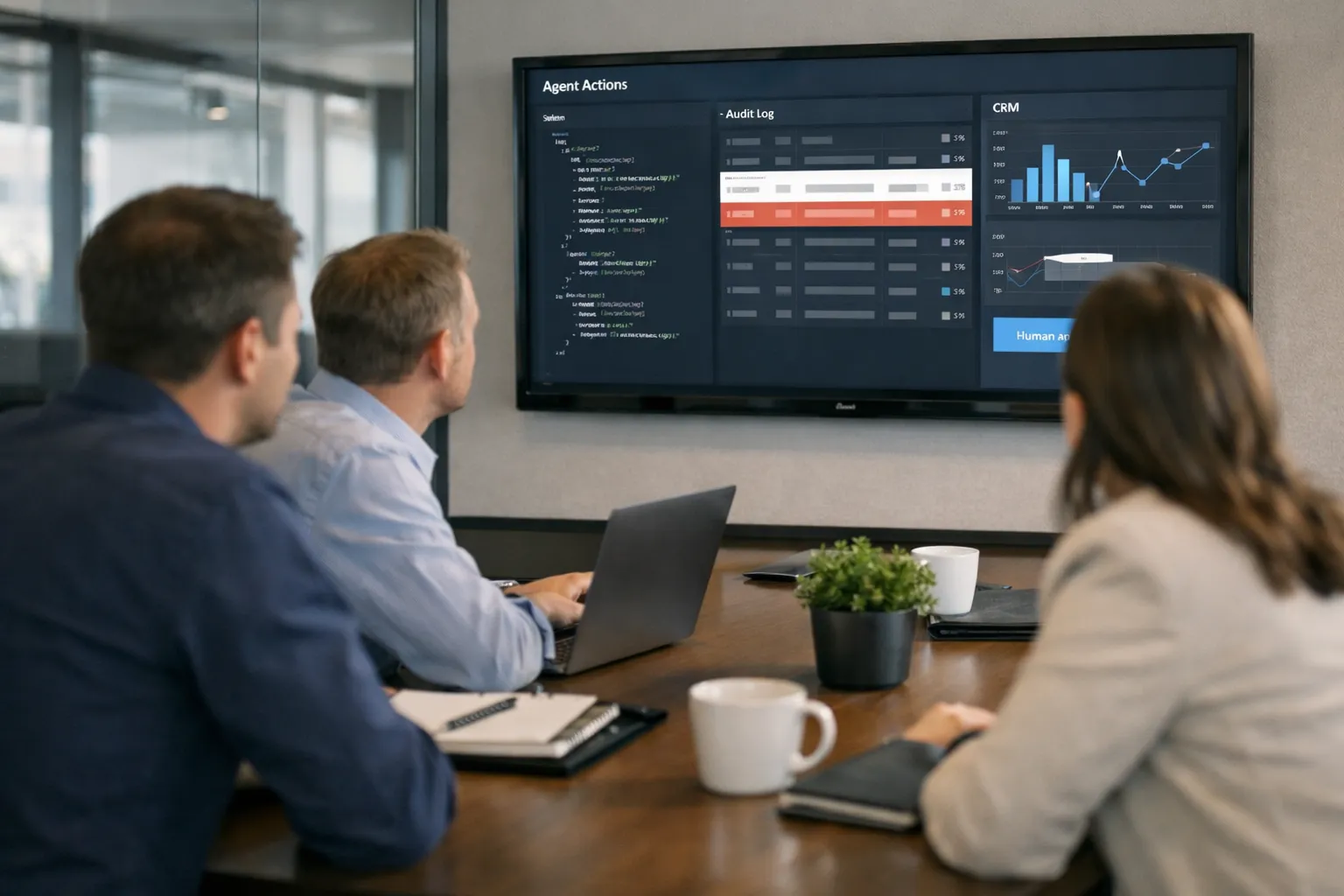
What readers will learn: how to design, build and safely operate LLM-powered autonomous agents for sales workflows in 2026. This update adds recent platform capabilities, governance patterns, multimodal signals, and operational best practices shaped by enterprise deployments through 2024–2026.
Who this is for: product leaders, sales ops, AI/ML engineers and security/compliance stakeholders planning production agent automation for CRMs, email and calendar systems.
Context and why this matters in 2026
Since early adopters deployed conversational and retrieval-based automation, vendor-managed agent frameworks and private LLMs have become mainstream. Large cloud providers and CRM vendors now offer integrated agent tooling and function-calling APIs; vector DBs and attribution tooling are standard parts of the stack. At the same time, regulatory scrutiny (transparency, data contracts and documented risk assessments) has increased. That combination makes now a practical moment to move from proofs-of-concept to production — but only with disciplined architecture, safety gates and measurable KPIs.
Prerequisites and updated team composition
Build on the original team list but add new roles and access requirements introduced by 2026:
- Product owner (sales leader) — defines outcomes and sales KPIs (conversion lift, lead velocity).
- AI/ML engineer or integration engineer — builds connectors, orchestration and model routing; manages private model containers when required.
- Prompt engineer / prompting specialist — designs prompts, tool invocation, and structured outputs; owns evaluation harnesses and synthetic test suites.
- Security/compliance lead — defines data handling, AI risk assessments (per the EU AI Act-style frameworks) and monitors access logs.
- Sales ops — CRM mappings, business logic and field-level rules.
- Platform/DevOps — manages vector DBs, model hosting (cloud or on-prem), and observability integration.
- Voice/Contact-center specialist (if using voice or real-time audio) — transcripts, call-routing, and consent handling.
When to use LLM agents in sales (updated guidance)
Use autonomous agents for multi-step tasks that combine freeform language and structured actions. Newer, high-value use cases in 2026 include:
- Inbound lead qualification with multimodal inputs: parsing web form text, uploaded documents, and short call transcripts before scoring.
- Contextual outreach: drafting personalized multi-touch sequences that reference recent product updates, support tickets, and contract milestones.
- Meeting prep with multimodal summary: synthesizing notes, transcript highlights and CRM history into an agenda with annotated citations.
- Data enrichment and identity resolution: joining CRM records with external firmographic sources under privacy rules.
Do not use agents to make single-step, high-stakes contract or pricing approvals without explicit human sign-off and an auditable decision trail.
Updated high-level architecture (2026)
Design for modularity and minimal blast radius. Additions in 2026: model routing, provenance, and a plug-in tool registry.
- Orchestration layer: service that coordinates workflows, tasks, retries and model routing. Should support canarying routes (small/cheap model vs. large/high-quality model) and backpressure for rate-limited APIs.
- Agent runtime: executes LLM calls, tool invocation (function-calling), streaming responses and action selection. Prefer containerized runtimes that can host private LLMs when vendor SLAs or data residency require it.
- State store: short-term conversational state (Redis) and an immutable audit DB that stores inputs, model prompts, tool outputs, chosen actions and actor IDs. Include content hashes and references to source documents for provenance.
- Knowledge layer: curated corporate corpus, vector DB for retrieval with source-attribution, and a document change feed to avoid stale context.
- Connector registry: authenticated connectors to CRM, email, calendar, telephony, knowledge systems, and 3rd-party data providers. Each connector should declare required scopes and risk level.
- Human-in-the-loop UI: lightweight approval workflows embedded in CRM or collaboration tools (Slack/Microsoft Teams), with inline diffs and a one-click approve/reject action.
- Observability and governance: action metrics, latency, cost per action, override rates, and tamper-evident audit logs. Integrate model cards, chain-of-custody metadata and risk-scoring.
- Tool registry / plugin store: catalog of deterministic tools (validators, canonicalizers, enrichment APIs). Agents should call tools for structured tasks rather than generate sensitive values directly.
Step-by-step implementation (updated 2026 roadmap)
Phase 1 — Discovery (1–2 weeks)
- Map 3–5 workflows and specify measurable outcomes beyond time saved — e.g., conversion rate lift, lead-to-opportunity velocity, and downstream pipeline impact.
- Inventory sources and data sensitivity levels (PII, contract data, financials). Tag fields with risk levels to drive routing decisions (private LLM vs. public API).
- Specify non-functional constraints: latency SLAs, data residency, encryption, retention, and auditability for compliance reviews.
- Create a minimal action taxonomy (SendEmail, UpdateCRM, ScheduleMeeting, Escalate, RequestApproval) and define success criteria per action.
Phase 2 — Design & safety (1–2 weeks)
- Design agent personas and limits. Example: Qualification Agent may ask two clarifying questions, write a CRM score, but may not alter opportunity amounts.
- Define safety gates and routing rules. For example: any output that references pricing, legal terms, or PII must be routed to a private model or human approval.
- Document audit trail requirements. Collect immutable logs that include prompt template IDs, input hashes, LLM model version, tool invocation records and outcome.
- Define data minimization and consent flows: redact or pseudonymize sensitive identifiers prior to external calls unless covered by contractual processing terms.
Phase 3 — Build connectors & orchestration (2–4 weeks)
- Implement least-privilege connectors. Use short-lived tokens, granular OAuth scopes and automated rotation. For Salesforce, use a scoped integration user and field-level permissions; for Microsoft Graph use app-only tokens with narrow permissions.
- Build orchestration that enforces idempotency keys and deterministic validators before any external side effect (e.g., pre-check for duplicate email sends).
- Implement model routing policy: default to small, fast models for templated drafts; escalate to larger models for summarization, ambiguity, or low-confidence cases.
Phase 4 — Agent runtime & prompt engineering (2–3 weeks)
- Adopt structured response formats and function-calling where supported. Enforce strict JSON schemas with field validation to reduce parsing and safety errors.
- Use retrieval-augmented generation with source attribution. Include the top N citations and a confidence metric in every generated summary.
- Implement context curation: include only the last N interactions and 2–3 authoritative knowledge snippets to control token costs and limit leakage.
- Introduce synthetic test suites: replay recorded leads and scripted edge cases against the agent to measure behavior and regression before each release.
Phase 5 — Safety layers & human-in-loop (1–2 weeks)
- Enforce approval policies programmatically: any message containing price or contract language is routed for human approval and blocked from outbound channels until approved.
- Implement deterministic validators and sandboxed tool execution for high-risk updates (e.g., canonicalize company names with a deterministic API instead of model output).
- Start with shadow mode for 2–4 weeks: log agent decisions and compare to human actions to calibrate thresholds and measure false-positive/negative rates.
Phase 6 — Testing, pilot and rollout (2–6 weeks)
- Pilot with a small rep group (5–15 users). Limit scope (inbound qualification only, no auto-send).
- Instrument daily KPIs and collect qualitative feedback from reps through structured surveys and session recordings (with consent).
- Iterate prompts, thresholds and routing rules. Expand scope only after meeting predefined error-rate and conversion-lift criteria.
Concrete 2026 example: Inbound qualification with voice transcripts
Flow:
- Trigger: new lead via form or a short initial discovery call uploaded as a transcript (auto-generated by a call platform, with speaker labels).
- Fetch context: company firmographics (from a dereferenced enrichment feed), recent support tickets, previous rep notes.
- Agent combines text and transcript highlights, runs RAG against the playbook, and produces a one-paragraph summary with 2 citation links and a lead score.
- If score ≥ threshold, agent creates a CRM lead record with standardized fields; if confidence 0.6 or transcript is noisy, route to a human rep for verification.
- Every outbound email created by an agent is initially queued for a rep review unless the rep opts-in for auto-send under monitored conditions.
Monitoring, metrics and observability (updated KPIs)
Essential KPIs to track from day one:
- Automation coverage (% of workflow events the agent handles)
- Automation success rate (% of agent actions executed without manual correction)
- Human override rate and mean time to override
- Lead qualification accuracy vs control (A/B test conversion lift, not just time savings)
- Model provenance: fraction of actions routed to private vs. public models
- Model cost per action and monthly inference spend
- Incidents tied to compliance (data leakage flags, opt-out violations)
Logs should be queryable and include prompt template ID, model version, input hash, output, action taken, and user override records. For regulated contexts retain logs and provenance for the required retention period and make them auditable.
Cost optimization tactics (2026)
- Tier models by task and route deterministically: small cheap models for template fills, larger models for summarization and escalations.
- Use model caching and instruction distillation to create smaller specialized models for frequent patterns.
- Limit token budgets, enforce stop sequences, and use chunking for long documents with retrieval-first strategies.
- Batch or aggregate summarization requests when possible to reduce per-call overhead.
- Track cost-per-conversion, not just tokens, to align spend with revenue impact.
Security, privacy and compliance (2026 emphasis)
- Use least-privilege service accounts and rotate keys. Apply field-level encryption for sensitive fields in the CRM and redact PII before external model calls unless covered by DPA.
- Maintain an AI risk assessment for each agent workflow (document data flows, third-party processors, and residual risk). Map controls to regulatory obligations (e.g., transparency, record-keeping).
- Require explicit user consent records when engaging customers via agents, and provide clear opt-out mechanisms for automated outreach.
- Keep a chain-of-custody record: which model version, which tool, and which connector executed every action.
Operational maintenance
- Weekly: review overrides and high-confidence failures; update prompts or business rules.
- Monthly: analyze model drift, revise routing thresholds and evaluate opportunities for instruction distillation or fine-tuning on synthetic labeled data.
- Quarterly: security and privacy review of connectors, scopes, and retention policies; update the AI risk assessment.
- Ongoing: train sales reps on interacting with agents and collecting structured feedback.
Rollout checklist (updated)
- 3–5 target workflows and measurable KPIs that map to revenue impact.
- Least-privilege connectors and token management in place; private model options defined for sensitive workflows.
- Prompt templates with structured output and schema validation.
- Human-in-loop UI and approval gates implemented for priced/contracted interactions.
- Observability, cost tracking and tamper-evident audit logs enabled.
- Pilot plan with shadow mode, synthetic tests, and staged expansion.
Common mistakes and how to avoid them
- Over-automation: avoid auto-sending until the agent’s precision and downstream conversion lift are proven.
- Excessive context or blind copying of CRM histories into prompts — curate slices and cite sources to limit privacy risk and cost.
- Lack of deterministic fallbacks: always include rule-based validators for critical updates (pricing, contract fields).
- Insufficient provenance: if you can’t show which model version made a decision, you can’t investigate incidents—log everything meaningful.
Pro tips
- Instrument A/B experiments that measure conversion or pipeline metrics, not just time saved; ROI proves value to stakeholders.
- Use function-calling for all structured side effects; treat the LLM as a planner and the system tools as executors.
- Maintain a model inventory with cards that document training data boundaries, intended uses and known limitations.
- Create a reusable test harness containing real-world failure cases and adversarial prompts to catch regressions before release.
FAQ
How do I choose between a public-hosted model and a private on-prem model?
Decide based on data sensitivity, latency, and regulatory needs. Use private/on-prem models for high-risk fields (pricing, contracts, PII) or when data residency rules require it. Use public hosted models for low-risk templated text and to reduce ops overhead. In practice, implement model routing that sends critical requests to private models and routine requests to hosted ones.
What minimum KPIs should I measure during a pilot?
Measure automation coverage, automation success rate (no human correction), human override rate, and a conversion-oriented metric (lead-to-opportunity conversion or pipeline contribution). Also monitor cost per action and incidents tied to compliance or data leakage.
How long should the shadow mode run before enabling side effects?
Run shadow mode long enough to achieve statistically meaningful comparisons against a control group — typically 2–4 weeks for small pilots, longer for larger populations. Use that time to tune prompts, validators and routing thresholds until error rates meet agreed limits.
What governance artifacts should I prepare for audits?
Prepare an AI risk assessment, data flow diagrams, an audit log of inputs/outputs and model versions, prompt template registry, approval gate rules, and demonstrable consent records for customer engagement. These artifacts are useful for internal compliance, external auditors and regulators.
Can agents handle real-time voice interactions?
Yes — in 2026 many deployments incorporate short call transcripts and real-time voice routing. Key controls are accurate speaker-attributed transcripts, explicit customer consent, low-latency routing for urgent escalations, and post-call human review where pricing or legal content was present.
Final recommendations
LLM-driven autonomous agents can materially improve sales productivity if deployed with clear boundaries, human oversight, and rigorous observability. Start small, instrument for revenue-oriented metrics, and use staged expansion with deterministic fallbacks. Prioritize structured outputs, provenance and auditable approval gates so your automation delivers value while keeping risk and cost controlled.