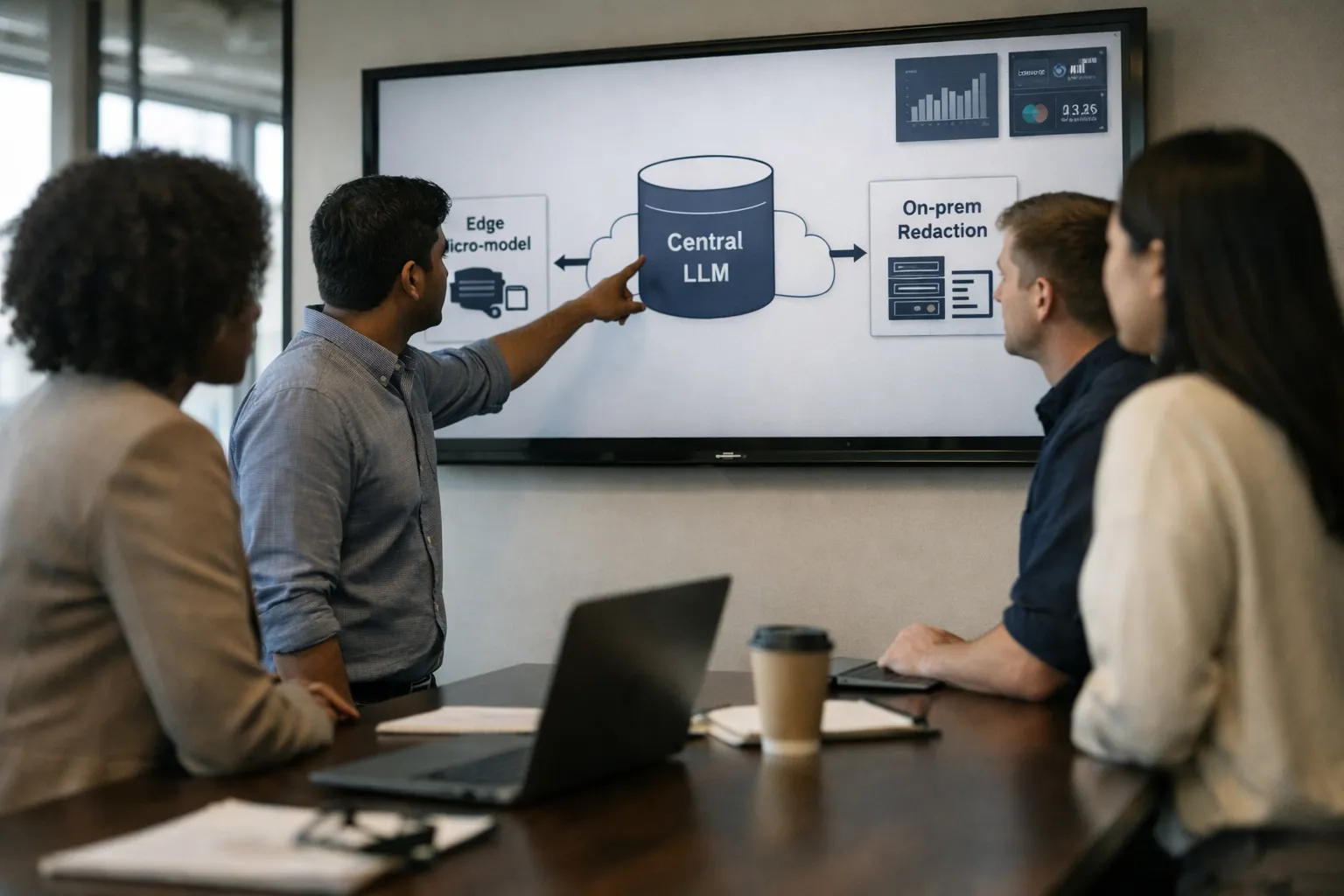
Overview: Enterprise AI architects in November 2026 face a refined set of choices between many small, specialized “micro-models” deployed close to users and centralized, large LLM instances in the cloud. Both approaches are production-ready, but the balance of trade-offs — cost, latency, capability, privacy and operational complexity — has shifted since mid‑2026. This update summarizes the latest technical advances, real-world adoption evidence, new regulatory and vendor dynamics, and provides actionable guidance and a short pilot framework CTOs and product leaders can use now.
Background: why the micro-model debate matters now
Two technical and two commercial forces continue to shape architectural decisions.
- Technical: Quantization, distillation and compiler toolchains matured through 2025–2026. Sub-13B models now routinely run with 4‑bit quantization and mixed-precision kernels on NPUs and inference accelerators, delivering capabilities once reserved for larger models.
- Operational: Model-ops platforms added signed artifact distribution, attestation, and multi-site canary orchestration, making distributed deployments safer and more auditable.
- Commercial: Cloud vendors extended managed edge inference offerings and regional private clouds; several third-party providers now offer turnkey micro-model distribution with contractual SLAs for regulated sectors.
- Regulatory: Enforcement and audit expectations for AI systems — including clearer guidance on data residency, explainability, and incident reporting — drove many organizations to prefer local preprocessing for sensitive inputs.
Data and evidence: what’s new in Nov 2026
- Adoption & economics. Recent industry surveys and vendor case studies indicate more enterprise pilots completed in 2026 than in 2025, with published breakeven analyses clustering around 6–18 months for steady, high-volume preprocessing (intent classification, PII redaction, routing). Reported cloud-inference savings for those workloads typically ranged from 20%–50% depending on volume and batchability.
- Performance gains. On-device runtimes and NPUs achieved consistent sub-100ms median latencies for classification and short summarization; well-optimized micro-models now return sub-50ms responses in controlled edge appliances for straightforward tasks.
- Tooling maturity. Model registries (artifact signing, provenance), telemetry with privacy-preserving aggregations, and automated canary/rollback pipelines became standard offerings from major MLOps vendors and cloud partners during 2026.
- Hybrid routing in production. More companies use confidence-scoring routing: micro-models handle the predictable fraction of traffic and escalate low-confidence or long-context queries to centralized LLMs. Measured deflection rates in production pilots frequently sit between 60%–85% for targeted tasks.
- Regulatory audits. Regulators and enterprise auditors increasingly expect documented model lineage and separation of duties; signed artifacts, hardware attestation and centralized governance records are now common audit artifacts.
Multiple perspectives: stakeholder priorities and friction points
- Product owners: Continue to prefer micro-models for deterministic, high-volume building blocks (intent classification, routing, PII redaction) because they improve UX and predictability. Product teams are increasingly metric-driven—demanding measurable latency, accuracy and cost per 1k requests.
- Platform/infra teams: Acknowledge that distributed inference is operationally heavier but report that modern model-ops tooling has lowered the incremental burden. Key concerns remain secret/key management, rollout governance, and telemetry pipelines that do not exfiltrate raw data.
- Security & compliance: Prefer local preprocessing to reduce sensitive-data surface area. Security teams now require signed models, secure boot and attestation on edge appliances, and artifact provenance for any micro-model deployed in regulated environments.
- Finance: Requires a 3‑year TCO model that includes hardware amortization, model-maintenance headcount and cloud inference savings; procurement increasingly asks for SLAs around managed micro-model services.
Updated trade-offs — what to measure today
Cost
Centralized LLM per-token costs remain dominant for long-context generation. Micro-models cut recurring cloud inference spend but add capex and ops. Practical metric: run a breakeven analysis that includes (a) monthly predictable request volume and batchability, (b) amortized edge hardware, (c) bandwidth and network egress, and (d) model lifecycle ops (deploy, monitor, update). Pilots in 2026 suggest breakeven often falls in 6–18 months for steady high-volume preprocessing; for low-volume or highly variable workloads, centralized models still win.
Latency & UX
Local execution is the decisive benefit for sub-second or offline apps. With modern NPUs and optimized runtimes, many classification and short-generation tasks now run deterministically under 100ms. Conversely, multi-turn, long-context synthesis still favors centralized LLMs for end-to-end coherence and fewer hallucinations when full knowledge graphs or enterprise corpora are required.
Accuracy & capability
Large LLMs remain superior for complex reasoning and cross-domain synthesis. But micro-models — combined with retrieval augmentations, targeted fine-tuning and continuous evaluation suites — meet business thresholds for many domain tasks (customer intent, legal clause extraction, domain summarization). Engineering the retrieval and validation layer is often the critical success factor.
Privacy & risk
Local preprocessing reduces exposure of raw PII and simplifies audit trails. However, distributing models increases attack surface unless mitigations are in place: hardware attestation, signed artifacts, encrypted keys, and periodic integrity checks. Organizations that adopted these controls report smoother audits and fewer policy exceptions.
Operational complexity
Operational overhead scales with deployment sites. Best practice: centralize governance (artifact registry, policy, evaluation) while decentralizing inference. Automate canaries and rollbacks, and instrument privacy-preserving telemetry so teams can detect drift without seeing raw inputs.
Prevailing hybrid patterns in late 2026
Hybrid architectures are the dominant enterprise pattern. Common, battle-tested patterns include:
- Sanitize-and-forward: Local micro-models perform PII redaction and intent extraction; centralized LLMs receive sanitized context for heavy synthesis and report generation.
- Tiered routing: Micro-models resolve high-confidence requests; low-confidence or long-context queries are escalated to central LLMs based on realtime confidence scoring.
- Edge retrieval + local compose: Cached enterprise knowledge at the edge plus micro-model assembly avoids cloud dependency for the majority of queries in field-service and retail scenarios.
- On‑prem private LLMs: Regulated organizations keep a private high-capacity LLM in approved data centers for fully on‑prem generation, with micro-models at the edge for preprocessing.
Operational tooling & recommended practices — what to implement now
- Model catalog and provenance: Maintain a single source of truth for model metadata, training data lineage, evaluation artifacts and signed release artifacts. Ensure artifact signing and attestation are enforced at deploy time.
- Routing feature flags: Build API-level routing that can shift traffic by sensitivity, latency or confidence, and expose real-time telemetry to revert changes quickly.
- Privacy-preserving telemetry: Collect drift signals without shipping PII—use aggregated counters, sketches and differentially private summaries for model health dashboards.
- Cost attribution: Track cost per model, per endpoint and per business unit including hardware amortization and ops labor to avoid blind spots in TCO.
- Continuous evaluation: Run standardized evaluation suites across micro and central paths; automate rollback on KPI regressions and keep human-in-the-loop for safety-critical flows.
Decision framework and pilot playbook (Nov 2026)
Run a short, measurable pilot before committing. Use these four lenses and operationalize them in a 6–8 week pilot:
- Sensitivity: If inputs cannot leave controlled environments, prioritize local preprocessing micro-models or on‑prem LLMs.
- Volume & predictability: High-volume, repeatable tasks are prime candidates for micro-models. If your predictable workload is substantial and continuous, micro-models often pay off.
- Latency & availability: Sub-second, offline, or deterministic latency needs favor micro-models; if multi-turn coherence is essential, central LLMs may be required.
- Ops capability: If you lack distributed CI/CD and governance, start with a narrow micro-model pilot or rely on managed offerings with strict SLAs and audit support.
Case context: where micro-models are winning in 2026
- Financial services: Transaction classification and PII redaction moved to on‑prem micro-models in many regional banks; central systems handle scenario generation and regulatory reporting.
- Healthcare: Hospitals deploy micro-models for de‑identification and code mapping at the edge, forwarding redacted records to centralized or approved on‑prem LLMs for clinical summarization.
- Customer support: Contact centers deploy micro-models in agent UIs for intent classification and routing, escalating complex threads to centralized LLMs that have access to enterprise knowledge bases.
- Manufacturing: Field devices use micro-models for anomaly detection and short-generation maintenance instructions when connectivity is low.
Risks, mitigations and governance checklist
- Enforce artifact signing and hardware attestation for every micro-model deployment.
- Standardize continuous evaluation suites and run them across micro and central paths.
- Use confidence thresholds and human escalation for safety-critical decisions.
- Track end-to-end cost including network, hardware and labor; require a 3‑year TCO before significant capex.
Recommendations for CTOs and product leaders — Nov 2026
- Run a focused 6–8 week pilot on a single high-volume preprocessing task (PII redaction, intent classification). Measure latency percentiles, cost-per-1k requests (including hardware amortization), accuracy vs gold data, confidence distributions, and operational incidents.
- Instrument micro and central paths identically so you can compare UX and model health.
- Design APIs and feature flags for dynamic rerouting between micro and central models without client changes.
- Insist on governance-first rollouts: model registry, signed releases, canary policies, and privacy-preserving telemetry are essential to scale safely.
Outlook: what to watch for next
Through 2027 expect three forces to matter most: (1) continued improvements in low-bit quantization and compiler optimizations that further expand micro-model capability; (2) stronger regulatory clarity and enforcement that will formalize audit requirements for distributed models; and (3) tighter managed offerings from cloud and MLOps vendors that reduce integration friction for distributed deployments. The net effect: micro-models will take a larger share of predictable, privacy-sensitive workloads while centralized LLMs remain the fast path for broad, complex generation.
FAQ: Operational questions teams ask now
How do I estimate when micro-models will pay off?
Run a breakeven analysis: estimate monthly predictable request volume and batchability, average latency requirement, proportion of requests that micro-models can handle, hardware cost (amortized), model maintenance labor, and cloud inference savings. For steady, high-volume preprocessing, pilots in 2026 commonly found breakeven within 6–18 months.
Can managed micro-model offerings eliminate governance work?
Managed offerings reduce friction—packaging, distribution, telemetry—but they do not eliminate governance responsibilities. You still need a model catalog, signed artifacts, and local security controls. Evaluate managed SLAs and audit support carefully for regulated deployments.
What metrics should I collect during a micro-model pilot?
Collect latency percentiles (P50/P95/P99), accuracy vs a gold dataset, confidence distributions, request volume and batchability, cost per 1k requests (including amortized hardware), drift signals, and privacy metrics (e.g., proportion of inputs redacted locally). Also track operational incidents and rollback frequency.
Can I mix different model families across the stack?
Yes. Many teams run different architectures for different responsibilities. The critical controls are consistent evaluation, versioning and governance so behavior differences are visible and auditable.
What’s the fastest improvement teams can make today?
Implement consistent telemetry and routing feature flags. Being able to quickly flip between micro and central paths and to view comparable metrics is the highest-leverage step before larger investments in hardware or model development.