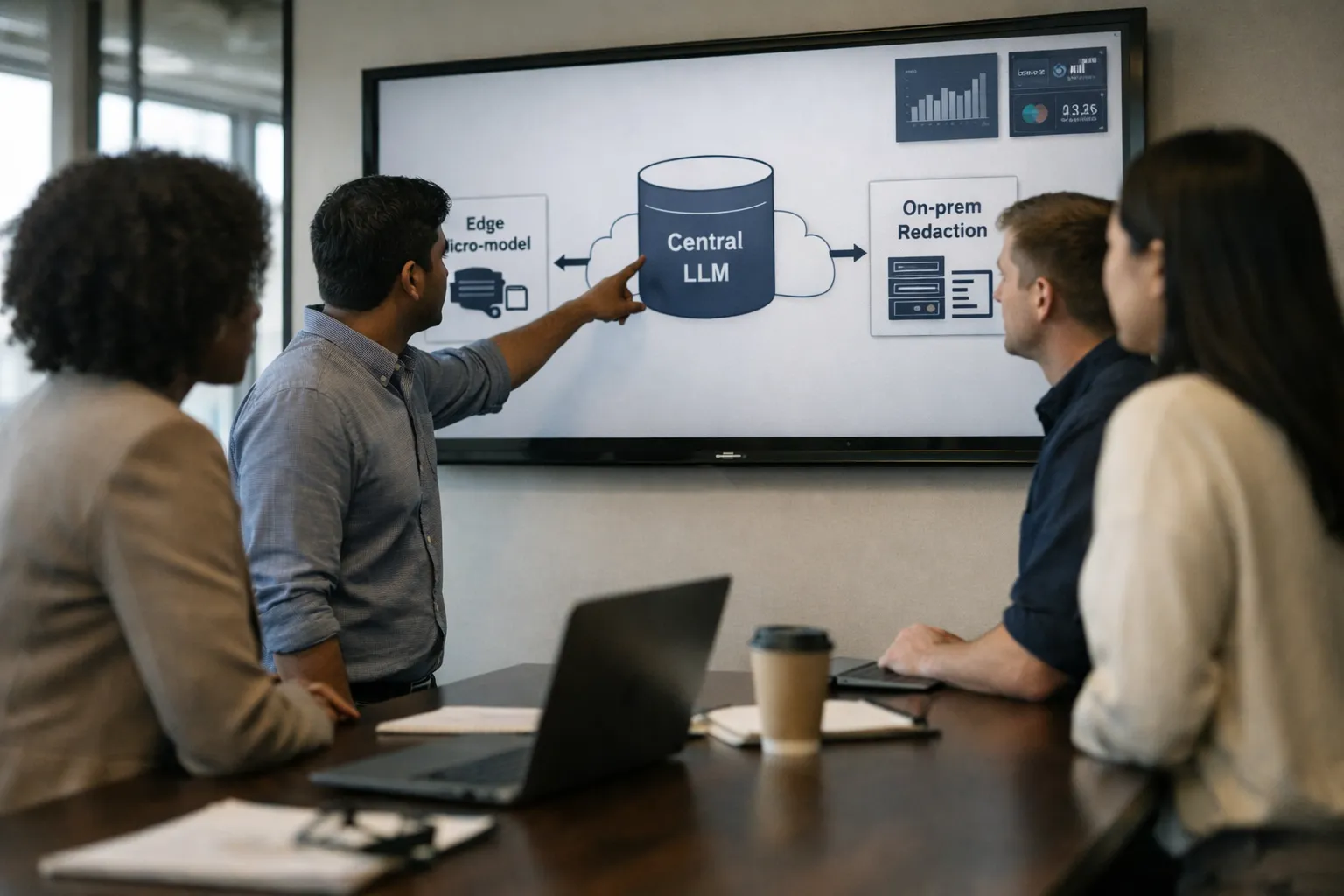
Overview: Enterprise AI architects in mid-2026 continue to face the practical choice between many small, specialized “micro-models” deployed close to users and centralized, large LLM instances hosted in the cloud. Both approaches are production-ready. This update explains what’s changed since March 2026, highlights recent industry developments, brings fresh examples and operational guidance, and offers a short decision framework CTOs and product leaders can apply now.
Background: What led to the renewed micro-model focus
Two concurrent forces shaped the 2024–2026 landscape. First, tooling and algorithmic advances — lower-precision quantization, improved distillation and parameter‑efficient fine-tuning (LoRA-style methods), and more robust on-device runtimes — made sub‑13B models far more capable for narrow tasks. Second, commercial and regulatory pressures pushed enterprises to limit cloud data movement for sensitive preprocessing. The original trade-offs (cost, latency, capability, operational complexity) still apply, but the balance has shifted: micro-models are now viable for a wider set of production workloads, and hybrid patterns are becoming the default for many organizations.
Data and evidence: What’s different in June 2026
- Broader deployment toolchains. The model operations ecosystem matured: model registries, signed artifact distribution, and canary systems from vendors (Hugging Face Hub, BentoML, Weights & Biases, and cloud partner integrations) are commonly used to manage distributed models.
- Runtime and quantization gains. Wider adoption of 4-bit and mixed-precision quantization, combined with improved compiler stacks for NPUs and GPUs, reduced inference memory and sped on‑device execution for many micro-models.
- Edge acceleration hardware. More enterprise-grade inference appliances and NPU cards (from established cloud partners and specialized vendors) reduced latency and made on-prem inference cost-competitive for steady workloads.
- Hybrid routing and retrieval at the edge. Retrieval-augmented micro-models (short context retrieval + local micro-inference) replaced several centralized calls for knowledge retrieval and short-form generation in customer support and field-service apps.
- Compliance pressure persists. Regulatory and contractual data-residency requirements — plus insurer scrutiny of AI governance in regulated sectors — continue to drive local preprocessing and policy enforcement patterns.
Multiple perspectives: Where stakeholders weigh in
- Product owners: Favor micro-models for deterministic building blocks (intent classification, PII redaction, routing) because predictability improves UX and lowers cloud spend for high-volume flows.
- Platform/infra teams: Point out that operational complexity is real — distributed deployments require CI for model artifacts, telemetry pipelines that respect privacy, and robust rollback practices.
- Security and compliance teams: Prefer micro-model preprocessing to minimize sensitive data exposure and to give auditors a clear separation of duties between policy enforcement and generative synthesis.
- Finance: Now routinely asks for a 3‑year TCO model that includes hardware amortization, model maintenance headcount, and cloud inference savings before approving micro-model rollouts.
Updated trade-offs — what to measure now
Cost
Centralized LLM per‑token or per‑inference costs remain higher for long-context generation; micro-models reduce recurring cloud inference but introduce hardware and ops cost. Updated practical metric: run a "breakeven analysis" that includes (a) expected request volume and batchability, (b) amortized edge hardware cost, and (c) model lifecycle ops (deploy, monitor, update). In mid‑2026, teams report breakeven horizons ranging from 6–24 months depending on volume and latency SLAs.
Latency & UX
Reduced network dependency is the decisive benefit for UX-sensitive applications. With mature local runtimes and NPUs, micro-models often deliver deterministic sub-100ms responses for classification and short summarization. For multi-turn, synthesis-heavy workflows requiring long context windows, centralized LLMs still provide superior user experience due to broader context handling.
Accuracy & capability
Large LLMs continue to lead on complex reasoning, long-document synthesis, and cross-domain generalization. However, micro-models — when combined with retrieval and careful fine-tuning and validation — now meet or exceed business thresholds for many tasks that previously required larger models (e.g., domain-specific summarization, intent routing, PII detection).
Privacy & risk
Micro-model preprocessing reduces attack surface for regulated data and simplifies audits, but distributed endpoints increase operational risk if updates and keys are not tightly controlled. Signed models, secure boot, and hardware attestation are now standard mitigation practices.
Operational complexity
Operational burden grows with the number of deployment sites. Best practice in 2026: centralize model governance (repository, policy, versioning) while decentralizing inference. This split reduces divergence risk while allowing localized execution.
Hybrid architectures: prevailing patterns in 2026
Hybrid is no longer a theoretical middle ground — it’s the dominant enterprise pattern. Common architectures include:
- Sanitize-and-forward: Micro-models do PII redaction and intent extraction locally; a centralized LLM receives redacted context for heavy synthesis.
- Tiered routing with prediction-based escalation: Micro-models handle predictable short tasks; a centralized model is invoked when confidence scores drop or when additional knowledge is required.
- Edge retrieval + local compose: Local caches hold user- or enterprise-specific knowledge and micro-models assemble concise responses without cloud calls for most queries.
- On-prem for regulated pipelines: Enterprises keep both micro-model and a private high-capacity LLM in approved data centers for fully on-prem generation where required by regulators.
Operational tooling and best practices — what to put in place today
- Model catalog and provenance: Maintain a single source of truth for model metadata, training data lineage, evaluation artifacts and signed release artifacts.
- Feature-flag routing: Build API-level routing that can route requests based on sensitivity, latency requirement, or confidence score, with real-time telemetry to revert paths quickly.
- Privacy-preserving telemetry: Collect metrics and drift signals without shipping raw user data: aggregate counts, sketch-based metrics, and DP-enabled summaries.
- Cost attribution dashboards: Track cost per model, per endpoint, and per business unit; include hardware amortization and ops labor to avoid blind spots in TCO.
- Canary and rollback automation: Signed artifacts + automated canary rollout for new micro-model versions and immediate automated rollback on KPI regressions.
Fresh, practical decision framework (June 2026)
When deciding architecture, weigh these four lenses and operationalize them in a short pilot:
- Sensitivity: If raw inputs cannot leave a controlled environment for contractual/regulatory reasons, prioritize local micro-model preprocessing or on‑prem LLMs.
- Volume & predictability: High-volume, repetitive tasks with stable patterns are prime for micro-models; keep centralized LLMs for ad-hoc or exploratory generation.
- Latency & availability: Sub-second, offline, or deterministic latency needs favor micro-models.
- Ops capability: If you can’t maintain distributed CI/CD and governance, favor centralized models or start with a narrow micro-model pilot that’s tightly governed.
Case patterns and real-world context
Across sectors through 2025–mid-2026, patterns solidified:
- Banking: Many banks run micro-models on-prem for transaction classification and PII filtering, with central LLMs reserved for scenario generation and regulatory reporting.
- Healthcare: Hospitals use micro-models for de-identification and code mapping at the edge and submit redacted cases to centralized or approved on‑prem models for clinical summarization.
- Customer support platforms: Large contact-center vendors ship micro-models for intent classification in the agent UI, forwarding complex threads to centralized models when agent context or enterprise knowledge is required.
Risks and mitigations — updated checklist
Key risks include model divergence, increased endpoints and attack surface, and hidden ops costs. Updated mitigations:
- Enforce signed artifacts and hardware attestation for model deployment.
- Standardize evaluation suites and run them continuously across micro and central paths.
- Use confidence thresholds and human-in-the-loop escalation for safety-critical decisions.
- Track end-to-end cost including network, hardware, and labor.
Recommendations for CTOs and product leaders — June 2026
- Run a six- to eight-week pilot: pick a single high-volume preprocessing task (PII redaction, intent classification) and measure latency, cost per thousand requests, error rate, and operational overhead.
- Instrument both micro and central paths identically so you can compare user experience and model health.
- Design APIs and feature flags to enable dynamic rerouting between micro and central models without client changes.
- Build a simple 3‑year financial model that includes hardware amortization, ops headcount, cloud inference, and expected growth in request volume.
- Start with a governance-first rollout: model registry, signed releases, canary policies, and privacy-preserving telemetry are essential to scale safely.
Outlook: what to watch for next
Through the rest of 2026, expect continued maturation of on-device runtimes, more standardized model governance frameworks, and growing innovation in hybrid routing and retrieval at the edge. The net effect: micro-models will cover a larger share of predictable, privacy-sensitive workloads while centralized LLMs remain the fast path for broad, complex generation.
FAQ: Operational questions teams ask now
How do I estimate when micro-models pay off?
Run a breakeven analysis: estimate monthly request volume, average latency requirement, expected proportion of requests that can be served by micro-models, hardware cost (amortized), model maintenance labor, and cloud inference savings. If your predictable workload is large and continuous, micro-models commonly break even within 6–24 months.
Can I avoid operational complexity by using a managed micro-model offering?
Managed offerings reduce some friction (packaging, distribution, telemetry) but do not eliminate governance needs. You still need a model catalog, signed artifacts, and local security controls. Evaluate managed SLAs carefully for multi-site and regulated deployments.
What metrics should I collect during a micro-model pilot?
Collect latency percentiles, error/accuracy vs. a gold dataset, confidence distributions, request volume and batchability, cost per 1k requests (including hardware amortization), and privacy-related metrics (e.g., proportion of inputs redacted locally). Also track operational incidents and rollback frequency.
Is it safe to mix different model families across the stack?
Yes — many teams run different model architectures for different responsibilities. The critical controls are consistent evaluation, versioning, and governance so behavior differences are visible and auditable.
What’s the single fastest improvement teams can make?
Implement consistent telemetry and routing feature flags. Being able to quickly flip between micro and central paths and to view comparable metrics is the highest-leverage step before larger investments in hardware or model development.